
DMEM高糖基础培养基
DMEM(Dulbecco's Modified Eagle Medium)是在MEM培养基的基础上研制的,与MEM培养基相比,氨基酸的含量增加了2倍,维生素的含量增加了4倍,同时还增加了非必须氨基酸、微量铁离子以及丙酮酸钠。
01产品图片
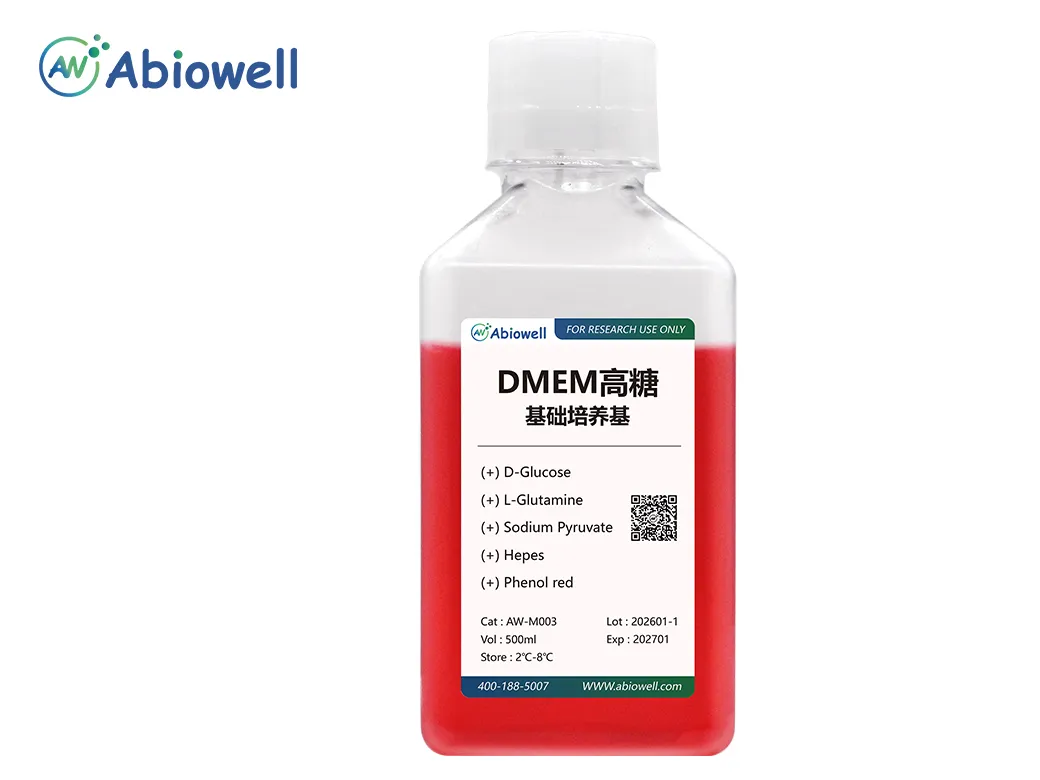
02产品简介
DMEM(Dulbecco's Modified Eagle Medium)是在MEM培养基的基础上研制的,与MEM培养基相比,氨基酸的含量增加了2倍,维生素的含量增加了4倍,同时还增加了非必须氨基酸、微量铁离子以及丙酮酸钠。
03产品介绍
DMEM(Dulbecco's Modified Eagle Medium)是在MEM培养基的基础上研制的,与MEM培养基相比,氨基酸的含量增加了2倍,维生素的含量增加了4倍,同时还增加了非必须氨基酸、微量铁离子以及丙酮酸钠。
DMEM高糖 基础培养基由abiowell技术团队精心筛选验证,经过长期测试,本产品可保持多种细胞最佳的生长状态。
形态液体 细菌检测阴性谷氨酰胺4mMD-葡萄糖4500mg/L丙酮酸钠1mM碳酸氢钠含有HEPES缓冲剂含有酚红含有存储条件2℃-8℃,避光储存运输条件常温或者蓝冰有效期12个月供应限制仅供科研使用
认真做好每一个抗体, 每一个抗体都经过反复验证!
Traditional Chinese medicine is gaining prominence in lumbar disc herniation (LDH) management, but the mechanisms of its active compounds and their molecular targets remain largely unclear. Herein, we aim to elucidate the therapeutic mechanism of Gentisic acid by investigating its role in regulating S100A9 in LDH. Clinical analysis reveals that S100A9 expression and inflammatory levels correlat positively with LDH severity. S100A9 is found to promote M1 macrophage polarization and impair dorsal root ganglion (DRG) neuronal activity. Mechanistically, Gentisic acid binds to MAPK14, downregulates S100A9 via MAPK14, and then suppresses M1 polarization, enhances neuronal autophagic flux, and improves neuronal viability through the S100A9/Rac1/2 pathway. In vivo experiments demonstrate that Gentisic acid ameliorates disc injury, improves neurological function, and alleviates pain in a rat LDH model, with efficacy comparable to celecoxib. These results suggest that Gentisic acid could alleviate LDH symptoms by modulating macrophage polarization and autophagy through the MAPK14/S100A9/Rac1/2 axis, offering a promising therapeutic strategy for LDH.
Authors:Li Shuoqi, Chen Tiezhu, Shen Xiongjie, Su Wanying, Li Xiaosheng
Ovarian cancer (OC) is a significant health challenge, yet the mechanisms driving its progression remain unclear. This study explored the role of hexokinase domain-containing protein 1 (HKDC1) in OC, focusing on tumor growth, lipid metabolism, and immune evasion. Human OC cell lines (SKOV3 and HEY) and the murine OC cell line (ID8) were used to knock down and overexpress HKDC1 . An ID8-based epithelial OC mouse model was established to validate the in vitro findings. Our results demonstrated that HKDC1 was upregulated in OC and promoted cell proliferation, migration, and invasion. HKDC1 enhanced lipid accumulation by elevating levels of free fatty acids (FFA), triglycerides, phospholipids, cholesterol, and neutral lipid, while upregulating key enzymes (ACC1, FASN, SCD1, HMGCS1, and HMGCR). It promoted immune escape through PD-L1 upregulation, inhibiting T cell proliferation and reducing IFN-γ, granzyme B, and perforin levels while increasing PD-1 levels. HKDC1 knockdown reversed these effects, which were restored by adding FFA. Mechanistically, HKDC1 interacted with and stabilized glucose-6-phosphatase catalytic subunits (G6PC/G6PC2), supporting its tumor-promoting functions. These findings were confirmed in an OC mouse model, highlighting HKDC1 as a key driver of OC progression through lipid biosynthesis and immune suppression, offering potential therapeutic targets.
Authors:Wang Ying, Chen Juan, Wang Zhan, Luo Xia, Wu Nayiyuan, Wang Jing MOLECULAR NUTRITION & FOOD RESEARCH IF:4.2
Saccharomyces boulardii ( S. boulardii ), a beneficial yeast probiotic, is effective in treating asthma in children. This study aimed to examine the effects of S. boulardii on Ovalbumin (OVA)-induced pyroptosis in human bronchial epithelial cells. An OVA-induced asthma mouse model was used with S. boulardii as an intervention. S. boulardii alleviated OVA-induced lung tissue pyroptosis and intestinal tissue damage in asthmatic mice. The mRNA sequencing analysis revealed differentially expressed genes, including elevated Cyba levels in the intestinal tissues of the OVA group. However, S. boulardii reduced Cyba levels. Gene Set Enrichment analysis showed the involvement of IL-17 signaling pathway. In vivo experiments showed that S. boulardii inhibited IL-17 signaling pathway in the intestinal and lung tissues. In vitro experiments revealed that IL-17 regulation of ROS production, promoting BEAS-2B cell pyroptosis, required the involvement of Cyba. Moreover, Cyba knockdown inhibited activation of NLRC4 and NLRP3 inflammasomes induced by IL-17 in vivo. This study revealed for the first time the important role of Cyba and IL-17 pathways in asthma pathology and demonstrated that S. boulardii exerted its therapeutic effects by modulating these pathways. These findings provided a basis for developing nutrition interventions targeting gut microbiota and immune health.
Authors:Zhifeng Chen, Lang Hu, Yue Yang, Yina Wang, Yayong Li, Jing Su, Guyi Wang, Subo Gong JOURNAL OF CELLULAR AND MOLECULAR MEDICINE IF:4.2
Heterotopic ossification (HO) is a crucial pathological process in which bone or calcification develop in skeletal muscle and surrounding soft tissues. Muscle-derived stromal cells (MDSC) are important muscle-resident mesenchymal progenitor cells and macrophage-derived oncostatin M (OSM) can induce osteogenic differentiation. Bu Yang Huan Wu (BYHW), which has a long history of use in restraining inflammation, can prevent osteogenic differentiation and HO formation while underlying mechanism is still unclear. The Janus kinase/signal transducer and activator of transcription (JAK/STAT) signalling pathway is an important pathway to regulate osteogenic differentiation of related cells. In this study, we investigated whether BYHW could inhibit osteogenesis effect of MDSC through OSM mediated by macrophages, and whether JAK/STAT pathway regulated this biological process. We found that activated macrophages promoted osteogenic differentiation of MDSC through OSM and BYHW could decrease the level of OSM and osteogenic activity of MDSC. Further, we confirmed the regulatory effect of JAK/STAT pathway, blocking this pathway could suppress the level of OSM and osteogenic differentiation of MDSC. We showed that BYHW could suppress osteogenic differentiation of MDSC through JAK/STAT signalling. These findings expand the application scope of traditional Chinese medicine and provide a basis for the further investigation of the potential therapeutic role of HO.
Authors:Guorui Cao, Shaoyun Zhang, Yuanping Liao, Chen Yue, Lanbo Yang, Jiayi Guo, Peijian Tong, Honglue Tan Authors:Yinzhuang Zhang, Zhijie Shen, Zhuoni Mao, Dan Huang, Chengyu Lou, Li Fang APPLIED BIOCHEMISTRY AND BIOTECHNOLOGY IF:3.3 Authors:Luo Xing, He Chaogui, Yang Bo, Yin Shuheng, Li Ke Authors:Fu Wei, Wu Sirui, Yan Yongting, Lin Meixin, Duan Meini, Wu Wenxia, You Xujun Authors:Yuan Liao, Wenxia Yao, Zhaoyu Liu, Qian Peng, Xinke Zhou, Mengyuan Xie, Zesen Mai Authors:Yanfang Zhang, Aimin Zhang, Jiale Yang, Furong Huang, Menghua Zhao, Li Huang, Juanmei Wang
AML12细胞专用培养基由abiowell技术团队精心筛选验证,经过长期测试,本产品可保持AML12细胞最佳的生长状态。本产品中已包含AML12细胞生长所需的各种成分,无需额外添加任何成分,可直接用于AML12细胞的体外培养。
04完整参数表
参数由厂商资料整理,采购前请以最终报价单与技术协议为准。
05荣誉与资质
该品牌暂未上传荣誉证书与资质文件。以下是平台可核验的公开信息,未上传项如实标注,不做推断。
- 营业执照未上传
- 品牌授权未上传
- 产品检测报告未上传
- 会员身份
- 收费会员
- 经营身份
- 原厂
- 成立年份
- 2016 年
- 所在地
- 湖南
- 收录条目
- 498 个
- 平台核验
- 平台代管
06品牌与供应商
公司产品涵盖抗体、细胞、培养基、质粒载体等多个领域,致力于为生命科学研究提供可靠的工具与解决方案。自创立以来,艾碧维始终秉持“求实、诚挚、勤勉、克己”的发展理念,坚持以自主研发与持续创新为核心动力。公司拥有百余人的团队,其中硕士及以上学历生物医学专业人才占比超过30%,包括博士4人,构建起一支结构合理、专业扎实的研发与服务队伍。通过设立研发部、生产部、市场与营销部、财务部等多功能部门,公司实现了从产品开发到市场推广的全流程管控。艾碧维不仅敢于质疑现状,积极为生命科学家突破技术壁垒提供支撑,更注重与客户的深度互动与合作,通过持续收集反馈、开展研发协作,提前预见并解决潜在问题。未来,公司将继续秉持“助力科研创新,让实验更简单”的使命,一步一个脚印地打造具有国际领先水平的技术研发与产业化平台,为全球生命科学领域的进步持续赋能。注意: 1.本公司产品仅供科研使用。
品牌资料由厂商公开信息与授权渠道核对整理;条目参数与价格以最终报价单为准。
07同类条目
同一子类内的条目才具备可比性。跨子类比较参数通常没有意义。
08同品牌其他条目
艾碧维 在本目录共 498 个条目,除本条外还有:
科研在线(TeleVM). DMEM高糖基础培养基(AW-M003)[EB/OL]. 产品目录, 2026-10-31. https://www.suprotek.cn/products/item/aw-m003.html.
TeleVM. (2026, October 31). DMEM高糖基础培养基(AW-M003). 产品目录. https://www.suprotek.cn/products/item/aw-m003.html
@misc{biocsp_item_aw_m003,
  title        = {DMEM高糖基础培养基(AW-M003)},
  author       = {{科研在线}},
  year         = {2026},
  howpublished = {产品目录},
  note         = {更新于 2026-10-31,产品目录},
  url          = {https://www.suprotek.cn/products/item/aw-m003.html}
}
GB/T 7714 用于中文论文与报告;APA 7 用于英文期刊;BibTeX 可直接导入 Zotero、EndNote 或 LaTeX。
许可:CC BY-NC 4.0 · 转载注明来源