
Goat anti-Mouse IgG (H+L) Secondary Antibody, Alexa Fluor 488
Product Details Host Species:GoatReactivity:MouseConcentration:1 mg/mL Clonality:PolyclonalIsotype:IgGConjugate:Alexa Fluor 488 Formulation:Liquid in PBS containing 50% glycerol, 1% BSA and 0.05% PC30
01产品图片
02产品简介
Product Details Host Species:GoatReactivity:MouseConcentration:1 mg/mL Clonality:PolyclonalIsotype:IgGConjugate:Alexa Fluor 488 Formulation:Liquid in PBS containing 50% glycerol, 1% BSA and 0.05% PC30
03产品介绍
Product Details Host Species:GoatReactivity:MouseConcentration:1 mg/mL Clonality:PolyclonalIsotype:IgGConjugate:Alexa Fluor 488 Formulation:Liquid in PBS containing 50% glycerol, 1% BSA and 0.05% PC300. Purification:Affinity-chromatography Storage:-20°C,store in dark,1 year Applications IF 1:100-1:1000 FCM 1:100-1:1000 Information Based on immunoelectrophoresis and/or ELISA, the antibody reacts with whole molecule mouse IgG. It also reacts with the light chains of other mouse immunoglobulins. No antibody was detected against non-immunoglobulin serum proteins. The antibody may cross-react with immunoglobulins from other species.RRIDAB_2924767
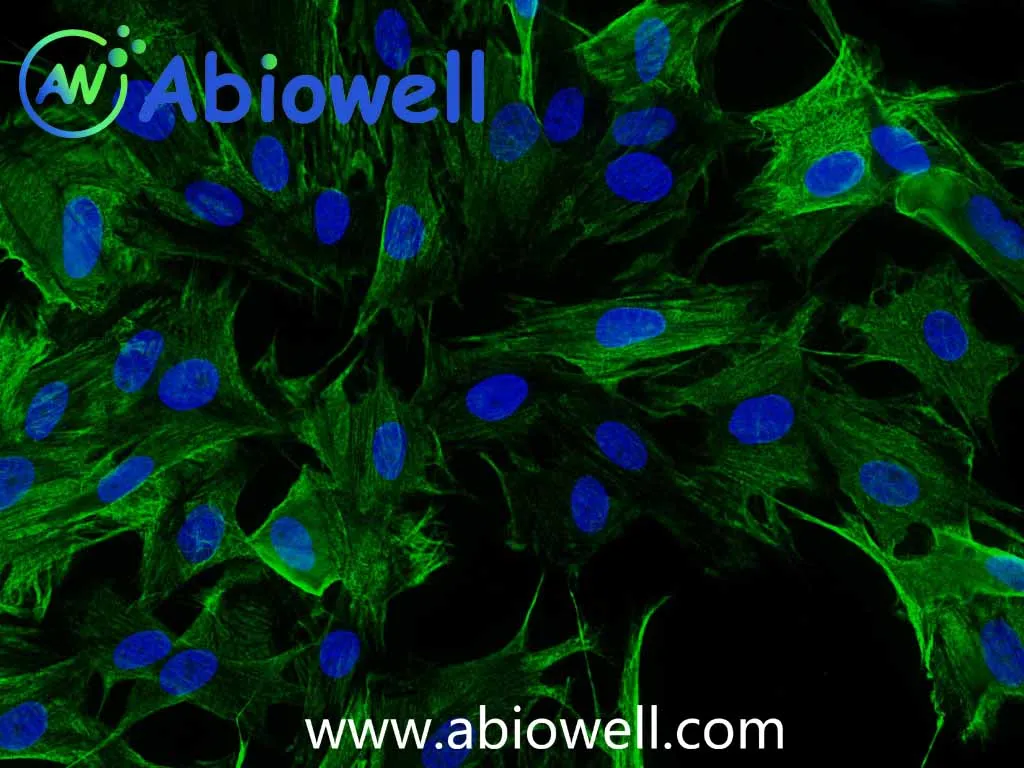
Product images Fig: Immunocytochemistry analysis of Mouse skin fibroblasts labeling Vimentin with mouse anti-Vimentin antibody (AWA00336)at 1/300 dilution (Green). Cells were fixed in 4% paraformaldehyde for 10 minutes at 37 ℃, permeabilized with 0.03% Triton X-100 in PBS for 30 minutes, and then blocked with 5% BSA for 60 minutes at 37 ℃. Cells were then incubated with Rabbit anti-Vimentin antibody (AWA00336)at 1/300 dilution in 2% negative goat serum overnight at 4 ℃. Goat Anti-Mouse IgG H&L (iFluor™ 488, AWS0003) was used as the secondary antibody at 1/200 dilution for 60 minutes at 37 ℃. Nuclear DNA was labelled in blue with DAPI(AWC0291). Fig: Immunocytochemistry analysis of HeLa cells labeling Citrate synthase with mouse anti-Citrate synthase antibody (AWA00889) at 1/250 dilution(green). Cells were fixed in 4% paraformaldehyde for 10 minutes at 37 ℃, permeabilized with 0.03% Triton X-100 in PBS for 30 minutes, and then blocked with 5% BSA for 60 minutes at 37 ℃. Cells were then incubated with mouse anti-Citrate synthase antibody (AWA00809) at 1/250 dilution in 2% negative goat serum overnight at 4 ℃. Goat anti-Mouse IgG (H+L) Secondary Antibody(Alexa Fluor 488, AWS0003) was used as the secondary antibody at 1/200 dilution for 60 minutes at 37 ℃. Nuclear DNA was labelled in blue with DAPI(AWC0291).
认真做好每一个抗体, 每一个抗体都经过反复验证!
Poly (adenosine 5′-diphosphate-ribose) polymerase inhibitors (PARPi) are increasingly important in the treatment of ovarian cancer. However, more than 40% of BRCA1/2-deficient patients do not respond to PARPi, and BRCA wild-type cases do not show obvious benefit. In this study, we demonstrated that progesterone acted synergistically with niraparib in ovarian cancer cells by enhancing niraparib-mediated DNA damage and death regardless of BRCA status. This synergy was validated in an ovarian cancer organoid model and in vivo experiments. Furthermore, we found that progesterone enhances the activity of niraparib in ovarian cancer through inducing ferroptosis by up-regulating palmitoleic acid and causing mitochondrial damage. In clinical cohort, it was observed that progesterone prolonged the survival of patients with ovarian cancer receiving PARPi as second-line maintenance therapy, and high progesterone receptor expression combined with low glutathione peroxidase 4 (GPX4) expression predicted better efficacy of PARPi in patients with ovarian cancer. These findings not only offer new therapeutic strategies for PARPi poor response ovarian cancer but also provide potential molecular markers for predicting the PARPi efficacy.
Authors:Li Fang, Zhijie Shen, Dan Huang, Chenyu Lou, Yalan Yu, Yuli Lin, Yinzhuang Zhang
Macrophage M2 polarization plays a pivotal role in breast cancer development. The present study aimed to investigate the interplay of the Leupaxin (LPXN)/HDAC6/EGR2 axis in breast cancer and its impact on macrophage M2 polarization. Our findings indicate that LPXN overexpression in breast cancer tissues correlates with M2 macrophage polarization. To investigate LPXN's potential role, we conducted siRNA-mediated silencing in macrophages. In a breast cancer cell-macrophage co-culture system, LPXN silencing was associated with reduced cancer cell proliferation, decreased M2 polarization markers, and diminished HDAC6 expression. BIOGRD and experimental data suggest a regulatory relationship between LPXN and HDAC6. Notably, HDAC6 inhibition partially reversed the pro-M2 effects of LPXN overexpression. Further mechanistic studies revealed that HDAC6 interacts with EGR2, functioning as its deacetylase and negatively regulating EGR2 expression. EGR2 silencing partially attenuated the anti-M2 effects observed with LPXN knockdown. In murine breast cancer models, LPXN silencing was linked to increased M1 macrophage markers and reduced tumor burden. These findings suggest LPXN may influence breast cancer progression through HDAC6/EGR2-mediated regulation of macrophage polarization. In conclusion, our study demonstrated that the LPXN/HDAC6/EGR2 axis promotes breast cancer progression by augmenting macrophage M2 polarization. Graphical
Authors:He Shaozhong, Wang Qun, He Jiayi, Chen Zhongyong, Xiao Yumei Authors:Xu Wenjing, Ding Jin, Kuang Shida, Li Bonan, Sun Tiansong, Zhu Congxu, Liu Juan, Zhu Lemei, Li Yingqiu, Sheng Wen AMERICAN JOURNAL OF CHINESE MEDICINE IF:5.7 Authors:Zhiyuan Hao, Zheyu Zhang, Yuhang Zhao, Dongsheng Wang AMERICAN JOURNAL OF PHYSIOLOGY-CELL PHYSIOLOGY IF:5.5
Oral squamous cell carcinoma (OSCC) is the most common type of oral cancer, and metastasis and immunosuppression are responsible for the poor prognosis of OSCC. Previous studies have shown that PARP1 plays a key role in the pathogenesis of OSCC. Therefore, targeting PARP1 may serve as an important research target for the potential treatment of OSCC. Here, we aimed to investigate the role of PARP1 in the tumorigenesis of OSCC and elucidate the key molecular mechanisms of its upstream and downstream regulation in vivo and in vitro. In human OSCC tissues and cells, TLR9 and PD-L1 were highly expressed and PARP1 was lowly expressed. Suppression of TLR9 remarkably repressed CAL27 and SCC9 cell proliferation, migration, and invasion. After co-culture, we found that low expression of TLR9 inhibited PD-L1 expression and immune escape. In addition, TLR9 regulated PD-L1 expression through the PARP1/STAT3 pathway. PARP1 mediated the effects of TLR9 on OSCC cell proliferation, migration, and invasion and immune escape. Additionally, in vivo experiments further verified that TLR9 promoted tumour growth and immune escape by inhibiting PARP1. Collectively, TLR9 activation induced immunosuppression and tumorigenesis via PARP1/PD-L1 signaling pathway in OSCC, providing important insights for subsequent in-depth exploration of the mechanism of OSCC.
Authors:Wenjun Zhao, Yuwei Zhang, Weijie Li, Quanzhi Hu, Haozhang Huang, Xian Xu, Bing Du, Pan Li Authors:Wangyang Li, Zebing Ma, Peng He, Wuji Xu, Xiaolan Liu, Jinlong Yao, Qiyao Wu, Pinglan Zou, Tiao Li
相关资料下载:说明书(.pdf)(点击从官网下载)
04完整参数表
参数由厂商资料整理,采购前请以最终报价单与技术协议为准。
05荣誉与资质
该品牌暂未上传荣誉证书与资质文件。以下是平台可核验的公开信息,未上传项如实标注,不做推断。
- 营业执照未上传
- 品牌授权未上传
- 产品检测报告未上传
- 会员身份
- 收费会员
- 经营身份
- 原厂
- 成立年份
- 2016 年
- 所在地
- 湖南
- 收录条目
- 498 个
- 平台核验
- 平台代管
06品牌与供应商
公司产品涵盖抗体、细胞、培养基、质粒载体等多个领域,致力于为生命科学研究提供可靠的工具与解决方案。自创立以来,艾碧维始终秉持“求实、诚挚、勤勉、克己”的发展理念,坚持以自主研发与持续创新为核心动力。公司拥有百余人的团队,其中硕士及以上学历生物医学专业人才占比超过30%,包括博士4人,构建起一支结构合理、专业扎实的研发与服务队伍。通过设立研发部、生产部、市场与营销部、财务部等多功能部门,公司实现了从产品开发到市场推广的全流程管控。艾碧维不仅敢于质疑现状,积极为生命科学家突破技术壁垒提供支撑,更注重与客户的深度互动与合作,通过持续收集反馈、开展研发协作,提前预见并解决潜在问题。未来,公司将继续秉持“助力科研创新,让实验更简单”的使命,一步一个脚印地打造具有国际领先水平的技术研发与产业化平台,为全球生命科学领域的进步持续赋能。注意: 1.本公司产品仅供科研使用。
品牌资料由厂商公开信息与授权渠道核对整理;条目参数与价格以最终报价单为准。
07同类条目
同一子类内的条目才具备可比性。跨子类比较参数通常没有意义。
08同品牌其他条目
艾碧维 在本目录共 498 个条目,除本条外还有:
科研在线(TeleVM). Goat anti-Mouse IgG (H+L) Secondary Antibody, Alexa Fluor 488(AWS0003)[EB/OL]. 产品目录, 2026-10-31. https://www.suprotek.cn/products/item/goat-anti-mouse-igg-h-l-secondary-antibody-alexa-fluor-488.html.
TeleVM. (2026, October 31). Goat anti-Mouse IgG (H+L) Secondary Antibody, Alexa Fluor 488(AWS0003). 产品目录. https://www.suprotek.cn/products/item/goat-anti-mouse-igg-h-l-secondary-antibody-alexa-fluor-488.html
@misc{biocsp_item_goat_anti_mouse_igg_h_l_secondary_antibody_alexa_fluor_488,
  title        = {Goat anti-Mouse IgG (H+L) Secondary Antibody, Alexa Fluor 488(AWS0003)},
  author       = {{科研在线}},
  year         = {2026},
  howpublished = {产品目录},
  note         = {更新于 2026-10-31,产品目录},
  url          = {https://www.suprotek.cn/products/item/goat-anti-mouse-igg-h-l-secondary-antibody-alexa-fluor-488.html}
}
GB/T 7714 用于中文论文与报告;APA 7 用于英文期刊;BibTeX 可直接导入 Zotero、EndNote 或 LaTeX。
许可:CC BY-NC 4.0 · 转载注明来源