
PE Anti-Mouse CD117 Antibody
英诺赛图(InnoCyto)的 PE Anti-Mouse CD117 Antibody(克隆 2B8) 为大鼠源 IgG2b 单克隆抗体,靶向 CD117(别名 CD-117 等),PE 标记(633 nm 红色激光激发),适用于流式细胞术。提供 50 μg、200 μg 规格,目录价 ¥1,085 起,仅供科研使用(RUO)。
01产品图片
02产品简介
英诺赛图(InnoCyto)的 PE Anti-Mouse CD117 Antibody(克隆 2B8) 为大鼠源 IgG2b 单克隆抗体,靶向 CD117(别名 CD-117 等),PE 标记(633 nm 红色激光激发),适用于流式细胞术。提供 50 μg、200 μg 规格,目录价 ¥1,085 起,仅供科研使用(RUO)。
03产品介绍
规格与货号
204109 | 50 μg | ¥1,085
204110 | 200 μg | ¥2,985
Product Details
Regulatory Status|RUO
Protein Concentration|0.2 mg/mL
Storage & Handling|The antibody solution should be stored undiluted between 2°C and 8°C, and protected from prolonged exposure to light. Do not freeze.
Recommended Usage|For flow cytometric staining, it is recommended to use less than 0.12 μg of this reagent per 0.5-1.0 million cells in a 100 μL volume. Optimal reagent performance should be determined by titration for each specific application. PE has an excitation max at 565 nm and an emission max at 575 nm.
See All Formats|Clone 2B8
Background Information
Mouse CD117, also known as c-Kit, is a receptor tyrosine kinase that plays a critical role in the regulation of hematopoiesis, stem cell maintenance, and the development of several specialized cell types. CD117 is encoded by the Kit gene and is expressed on hematopoietic stem and progenitor cells, mast cells, melanocytes, germ cells, and certain progenitors in multiple tissues. In the immune system, CD117 is particularly well known as a marker of mast cells and early hematopoietic stem cells, where it regulates cell survival, proliferation, and differentiation.
Structurally, CD117 is a transmembrane glycoprotein belonging to the type III receptor tyrosine kinase family, which also includes receptors such as FLT3 and PDGFR. The receptor consists of an extracellular domain containing five immunoglobulin-like domains responsible for ligand binding, a single transmembrane region, and a cytoplasmic domain with intrinsic tyrosine kinase activity. Upon ligand binding, CD117 undergoes receptor dimerization, which triggers autophosphorylation of specific tyrosine residues within the intracellular domain. These phosphorylated sites then recruit signaling molecules that activate downstream pathways, including the PI3K–AKT, MAPK, and JAK/STAT signaling cascades.
The primary ligand for CD117 is stem cell factor (SCF), also known as Kit ligand or steel factor. SCF exists in both membrane-bound and soluble forms and is produced by stromal cells in the bone marrow and other tissues. Binding of SCF to CD117 promotes survival and expansion of hematopoietic stem cells, supports mast cell development, and contributes to the migration and differentiation of various progenitor cell populations. Because of this central signaling pathway, the SCF–CD117 axis is essential for normal blood cell formation and tissue homeostasis.
CD117 is also implicated in several diseases. Gain-of-function mutations in the Kit gene can lead to constitutive activation of the receptor and uncontrolled cellular proliferation. In mice and humans, such mutations are associated with disorders including mastocytosis, gastrointestinal stromal tumors (GIST), and certain leukemias. Conversely, loss-of-function mutations in Kit can disrupt hematopoiesis, pigmentation, and fertility, reflecting the broad biological roles of CD117 signaling.
Because of its involvement in cancer and stem cell biology, CD117 has become an important therapeutic target. Small-molecule tyrosine kinase inhibitors that block CD117 signaling, such as imatinib, have shown significant clinical benefit in diseases driven by KIT activation, particularly GIST. In research and experimental therapy, antibodies against CD117 are also used to identify and isolate hematopoietic stem cells and to condition recipients for stem cell transplantation by selectively depleting stem cell niches. These strategies highlight the importance of CD117 as both a biological marker and a therapeutic target in hematology and oncology.
Data Sheets
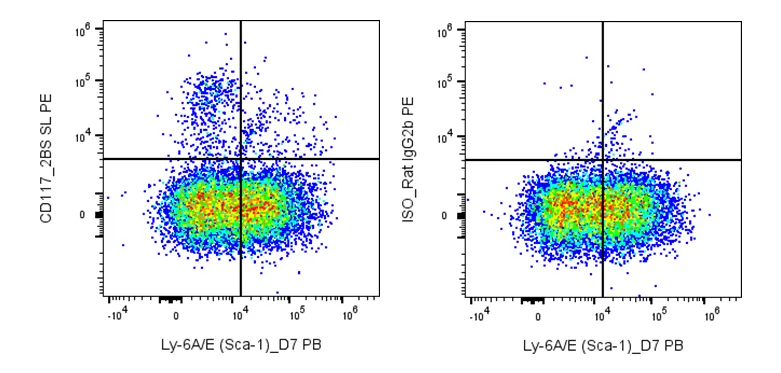
C57BL/6 Mouse splenocytes were stained with PB Anti-Mouse Ly-6A/E (Sca-1) clone D7 and PE Anti-Mouse CD117 clone 2B8 (left) or an isotype control (right).
04完整参数表
参数由厂商资料整理,采购前请以最终报价单与技术协议为准。
05荣誉与资质
该品牌暂未上传荣誉证书与资质文件。以下是平台可核验的公开信息,未上传项如实标注,不做推断。
- 营业执照未上传
- 品牌授权未上传
- 产品检测报告未上传
- 会员身份
- 收费会员
- 经营身份
- 原厂
- 成立年份
- 2020 年
- 所在地
- 上海
- 收录条目
- 1865 个
- 平台核验
- 平台代管
06品牌与供应商
InnoCyto(上海英诺赛图生物科技有限公司)致力于通过开发高质量细胞分析试剂,加速科学发现进程。公司为研究人员提供细胞层面探索所需的工具,推动免疫学、肿瘤学等多领域的研究创新。 核心团队拥有丰富的行业经验,曾参与全球头部生命科学公司的标杆项目搭建,深刻理解工业界与学术研究的前沿需求。试剂从设计之初即以精确性、一致性、高性能为核心标准,让科学家能把精力集中在最核心的研究工作上。 公司将深厚的科学积累与对品质的严格承诺相结合,力争成为全球研究人员信赖的合作伙伴。产品线覆盖经验证的一抗与二抗、同型对照、生物类似药抗体、重组蛋白、细胞因子、免疫检测试剂盒及配套试剂,并提供重组蛋白/抗体表达与标记偶联服务。
品牌资料由厂商公开信息与授权渠道核对整理;条目参数与价格以最终报价单为准。
07同类条目
同一子类内的条目才具备可比性。跨子类比较参数通常没有意义。
08同品牌其他条目
上海英诺赛图 在本目录共 1865 个条目,除本条外还有:
科研在线(TeleVM). PE Anti-Mouse CD117 Antibody(204109)[EB/OL]. 产品目录, 2026-11-12. https://www.suprotek.cn/products/item/pe-anti-mouse-cd117-antibody.html.
TeleVM. (2026, November 12). PE Anti-Mouse CD117 Antibody(204109). 产品目录. https://www.suprotek.cn/products/item/pe-anti-mouse-cd117-antibody.html
@misc{biocsp_item_pe_anti_mouse_cd117_antibody,
  title        = {PE Anti-Mouse CD117 Antibody(204109)},
  author       = {{科研在线}},
  year         = {2026},
  howpublished = {产品目录},
  note         = {更新于 2026-11-12,产品目录},
  url          = {https://www.suprotek.cn/products/item/pe-anti-mouse-cd117-antibody.html}
}
GB/T 7714 用于中文论文与报告;APA 7 用于英文期刊;BibTeX 可直接导入 Zotero、EndNote 或 LaTeX。
许可:CC BY-NC 4.0 · 转载注明来源